Business
4 Best Practices for Securing Your Artificial Intelligence Data Center
Published June 29, 2026
Introduction
The evolution of artificial intelligence has necessitated a reevaluation of security protocols within data centers. As AI evolves, organizations face increasing challenges in securing their data centers. This article outlines four best practices for securing AI data centers, detailing essential strategies organizations can implement to protect their infrastructure from emerging threats. Organizations must adopt a proactive stance to mitigate the risks associated with advanced cyber threats.
Establish Robust Infrastructure for AI Data Centers
Inadequate security measures can expose the artificial intelligence data center to significant risks, necessitating a comprehensive approach to infrastructure security. To secure your infrastructure for the artificial intelligence data center, begin by establishing a robust system that includes both physical and virtual components. This involves:
- Physical Security Measures: Implement advanced physical security protocols such as biometric access controls, surveillance cameras, and secure entry points to prevent unauthorized access. Observing non-wired communication routes aids boundary protection goals, as wireless threats frequently remain unnoticed by conventional protective tools, according to Joseph Salazar.
- Network Segmentation: Design your network architecture to segment sensitive AI workloads from less critical systems. This limits the potential impact of a breach, ensuring that any compromise is contained and does not affect the entire infrastructure.
- Redundant Systems: Ensure redundancy in power supply, cooling systems, and network connections to maintain operations during failures or attacks. Continuous monitoring, as outlined in NIST SP 800-137, is vital for ensuring operational integrity in high-stakes environments.
- Compliance with Standards: Adhere to industry standards such as ANSI/TIA-942 for data center design, which outlines requirements for telecommunications, power, and cooling. Furthermore, adherence to NIST SP 800-53 creates a thorough framework for safeguarding systems within the artificial intelligence data center that support AI workloads, improving protection and aligning with best practices acknowledged throughout the industry.
Failure to adhere to these standards may lead to vulnerabilities that expose critical systems to attacks. Recognizing and addressing these vulnerabilities is essential for maintaining the integrity of AI operations and safeguarding sensitive data.

Conduct Regular Security Assessments and Penetration Testing
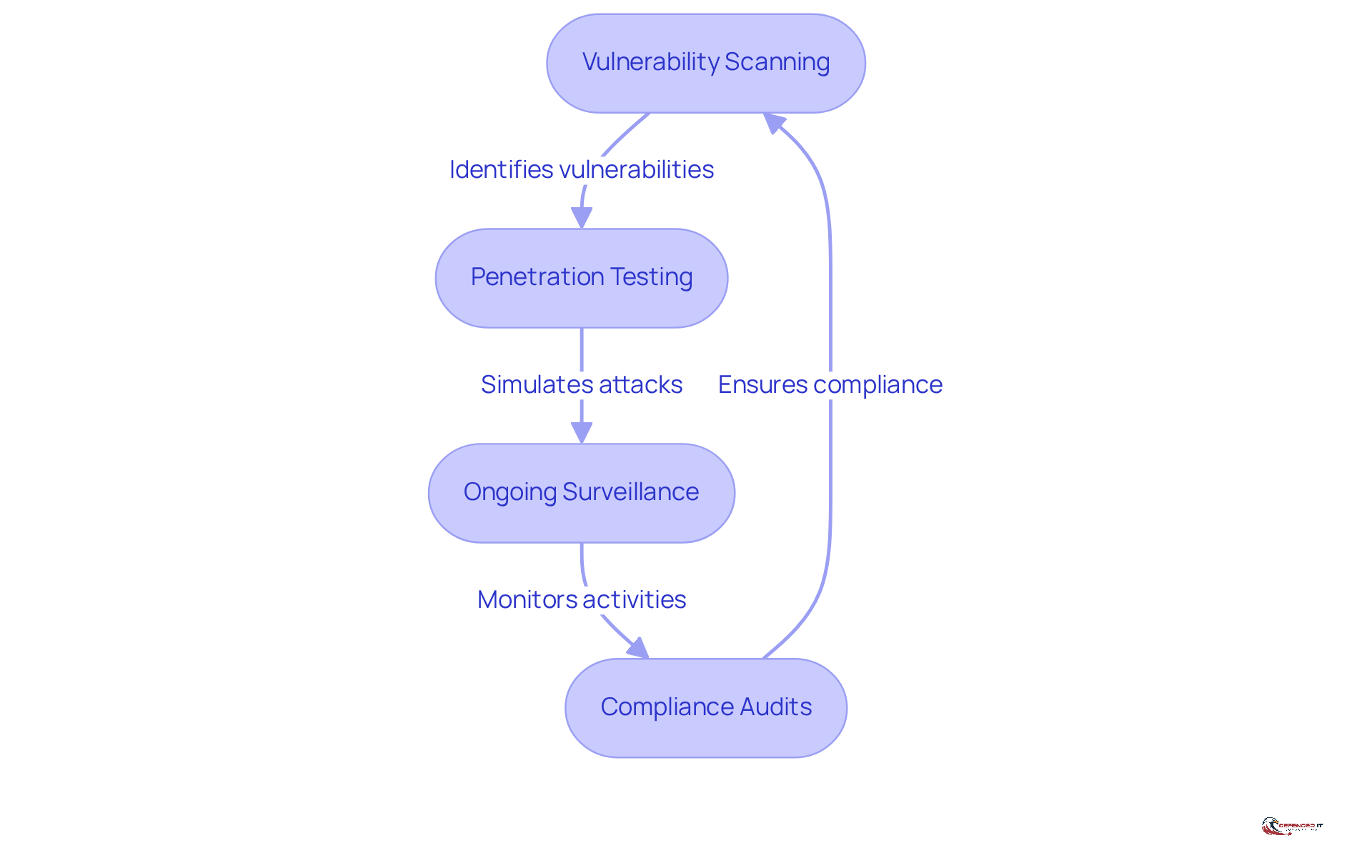
To effectively safeguard against cyber threats, organizations must adopt a proactive approach that includes regular evaluations and penetration testing. This includes:
- Vulnerability Scanning: Employ automated tools to routinely scan for known vulnerabilities within systems and applications, ensuring that potential weaknesses are identified promptly.
- Penetration Testing: Conduct simulated attacks to uncover vulnerabilities in defenses. Involving outside specialists offers an impartial assessment of protective measures, improving the efficiency of the testing process. Penetration testing supports compliance efforts for frameworks like NIST AI RMF and ISO/IEC 42001, reinforcing the importance of these assessments.
- Ongoing Surveillance: Implement solutions that provide real-time notifications on suspicious activities, enabling swift reactions to potential threats and reducing the impact of incidents.
- Compliance Audits: Regularly evaluate adherence to applicable regulations and standards, ensuring that protective measures align with industry requirements and best practices.
By incorporating these practices, organizations can better spot and tackle vulnerabilities, which significantly lowers the chances of successful cyber attacks. For example, case studies have demonstrated that entities utilizing continuous risk exposure management (CTEM) along with penetration testing can effectively validate their defenses under simulated pressure, ensuring a proactive protective stance. As the cybersecurity landscape changes, the necessity for regular evaluations becomes more essential, especially in light of new challenges aimed at AI systems. Experts stress that penetration testing is not just a compliance requirement but an essential part of continuous security management, assisting organizations in staying ahead of potential vulnerabilities and adjusting to the evolving risk landscape. Without these proactive measures, organizations risk not only their data but also their reputation and financial stability in an increasingly hostile cyber environment.
Leverage Threat Intelligence for Proactive Defense
Integrating risk intelligence into cybersecurity strategies is essential for staying ahead of evolving threats. Key practices include:
- Threat Intelligence Platforms: Leverage platforms that consolidate threat data from diverse sources, offering insights into emerging threats and vulnerabilities. This approach allows entities to stay ahead of potential risks by transforming raw data into actionable intelligence through contextual enrichment and prioritization tailored to specific industry needs.
- Collaboration with Industry Peers: An example of this collaborative model is the Cyber Threat Alliance (CTA), formed by companies such as Fortinet, McAfee, Symantec, and Palo Alto Networks. Actively engaging in information sharing with other entities within your sector increases awareness of the most recent risks and attack methods, promoting a unified defense approach that can greatly enhance response times and efficiency against cyber incidents.
- Automated Risk Detection: Implement AI-driven tools that analyze risk data and automatically adjust security measures based on real-time intelligence. This capability is crucial as adversaries are increasingly using AI, leading to a reported 89% rise in attacks from AI-enabled threats by 2025. Automated systems can assist entities in reacting to dangers more swiftly, decreasing the average eCrime breakout duration, which fell to only 29 minutes, indicating a 65% boost in speed from 2024.
- Regular Updates: Ensure that intelligence feeds are consistently updated to reflect the latest risk landscape. This practice enables entities to respond promptly to new vulnerabilities, addressing the critical need for real-time visibility and automated response capabilities in today’s dynamic network environments.
By effectively utilizing threat intelligence, entities can significantly improve their protective stance and reduce the likelihood of successful cyberattacks. This proactive approach not only fortifies defenses but also positions entities to respond effectively to the ever-changing cyber threat landscape.

Develop Incident Response Plans and Ensure Compliance
To effectively manage security incidents, organizations must prioritize the development of comprehensive incident response plans that address critical components:
- Incident Response Team: Establish a dedicated team responsible for managing security incidents. This team should incorporate clearly defined roles and responsibilities for each member, ensuring that everyone understands their specific duties during an event. Cooperation within the team is crucial for efficient event management.
- Response Procedures: Develop comprehensive protocols for recognizing, managing, and eliminating dangers, as well as recuperating from events. These procedures should align with the NIST Incident Response Lifecycle, which includes preparation, detection, analysis, containment, eradication, recovery, and post-incident activities. Grasping these phases is essential for a well-organized response.
- Regular Training and Drills: Conduct regular training sessions and simulation exercises to ensure that all team members are familiar with their roles and can respond effectively under pressure. Ongoing training improves the team’s capacity to handle situations and adjust to changing threats. Organizations with proven response strategies can lower breach expenses considerably, averaging $2.66 million less than those lacking them.
- Compliance Considerations: Ensure that your response plan adheres to relevant regulations and standards, such as GDPR or HIPAA. Adhering to these regulations not only avoids legal repercussions but also enhances organizational reputation and instills confidence among stakeholders. Its aim is to reduce the effect of breaches, data leaks, malware attacks, and other possible threats while ensuring business continuity.
A robust incident response plan not only protects organizational assets but also fortifies stakeholder confidence in the face of potential threats.

Conclusion
In an era where cyber threats are increasingly sophisticated, securing artificial intelligence data centers has become a critical priority for organizations. Organizations can significantly enhance their defenses against potential cyber threats by implementing robust infrastructure and conducting regular security assessments. Leveraging threat intelligence and developing comprehensive incident response plans further strengthens these defenses. These practices help safeguard sensitive data while also ensuring that operations run smoothly and comply with industry standards.
Key strategies discussed include:
- The importance of physical security measures
- Network segmentation
- Redundancy in systems to mitigate risks
Regular vulnerability scanning and penetration testing are essential for identifying weaknesses, while threat intelligence platforms and collaboration with industry peers provide valuable insights into emerging threats. Furthermore, a well-structured incident response plan is crucial for managing security incidents effectively, ensuring that organizations can respond swiftly and efficiently to any breaches.
Without these measures, organizations risk not only data breaches but also reputational damage and loss of stakeholder trust. As the landscape of cyber risks evolves, organizations that fail to adapt their security strategies may find themselves vulnerable to unprecedented threats. Organizations are encouraged to prioritize these best practices, fostering a culture of security that adapts to the ever-changing landscape of cyber risks.
Frequently Asked Questions
What is the importance of establishing robust infrastructure for AI data centers?
Establishing robust infrastructure is crucial for securing AI data centers against significant risks, ensuring both physical and virtual components are adequately protected.
What physical security measures should be implemented in AI data centers?
Advanced physical security measures include biometric access controls, surveillance cameras, and secure entry points to prevent unauthorized access, along with monitoring non-wired communication routes to protect against wireless threats.
How can network segmentation enhance security in AI data centers?
Network segmentation involves designing the network architecture to separate sensitive AI workloads from less critical systems, which limits the impact of a breach and helps contain any compromises.
Why is redundancy important in AI data center infrastructure?
Redundancy in power supply, cooling systems, and network connections is essential to maintain operations during failures or attacks, ensuring continuous monitoring and operational integrity.
What industry standards should be followed for AI data center design?
Adhering to standards such as ANSI/TIA-942 for data center design and NIST SP 800-53 for safeguarding systems is vital for improving protection and aligning with best practices in the industry.
What are the consequences of failing to adhere to security standards in AI data centers?
Failure to adhere to security standards can lead to vulnerabilities that expose critical systems to attacks, compromising the integrity of AI operations and the safety of sensitive data.
List of Sources
- Establish Robust Infrastructure for AI Data Centers
- New Best Practices Guide for Securing AI Data Released | CISA (https://cisa.gov/news-events/alerts/2025/05/22/new-best-practices-guide-securing-ai-data-released)
- From Data Centers to Models: White House Targets AI Risks (https://datacenterknowledge.com/cybersecurity/from-data-centers-to-models-white-house-targets-ai-risk-at-the-source)
- Navigating AI threats: Best practices for data center cybersecurity (https://blog.se.com/datacenter/2025/01/30/navigating-ai-threats-best-practices-data-center-cybersecurity)
- Government AI Data Center Security Best Practices (https://bastille.net/government-ai-data-center-security-practices)
- Data Centers Confront Rising Cyber and Physical Security Threats, Bloomberg Law (https://morganlewis.com/news/2026/04/data-centers-confront-rising-cyber-and-physical-security-threats)
- Conduct Regular Security Assessments and Penetration Testing
- Emerging Trends in Advanced Penetration Testing (https://info.janusassociates.com/blog/emerging-trends-in-advanced-penetration-testing)
- Trava Security (https://travasecurity.com/learn-with-trava/blog/the-impact-of-penetration-testing-in-ai)
- Next-Gen Pentesting: AI Empowers the Good Guys | Andreessen Horowitz (https://a16z.com/next-gen-pentesting-ai-empowers-the-good-guys)
- AI Decline? Confidence Falls in Autonomous Penetration Testing (https://darkreading.com/cybersecurity-operations/ai-decline-confidence-autonomous-penetration-testing)
- 205 Cybersecurity Stats and Facts for 2026 (https://vikingcloud.com/blog/cybersecurity-statistics)
- Leverage Threat Intelligence for Proactive Defense
- Fortinet 2026 Global Threat Landscape Report (https://fortinet.com/resources/reports/threat-landscape-report)
- CrowdStrike 2026 Global Threat Report | Key Cyber Threat Trends (https://crowdstrike.com/en-us/global-threat-report)
- Secure Multi-Industry Threat Intelligence Sharing for Collective Defense | Cyware (https://cyware.com/platform/multi-industry-threat-sharing)
- The Value of Collaborative Threat Intelligence Sharing (https://cyberthreatalliance.org/value-collaborative-threat-intelligence-sharing)
- Introducing the 2026 Cloudflare Threat Report (https://blog.cloudflare.com/2026-threat-report)
- Develop Incident Response Plans and Ensure Compliance
- What Is an Incident Response Plan (IRP)? (https://paloaltonetworks.com/cyberpedia/incident-response-plan)
- The Critical Importance of a Robust Incident Response Plan in 2025 | Sygnia (https://sygnia.co/blog/critical-importance-incident-response-plan)
- Incident Response: Importance of an Effective Incident Response Team in Cybersecurity | CyberMaxx (https://cybermaxx.com/incident-response-importance)
- What is an Incident Response Plan? Know the 5 Basic Steps (https://bitsight.com/blog/how-create-incident-response-plan-5-steps)