Business
Digital Consulting Firms vs. Traditional: Cybersecurity Insights for You
Published June 7, 2026
Introduction
As organizations confront the dual challenges of technological advancement and escalating cyber threats, the effectiveness of consulting approaches comes into question. Digital consulting firms are emerging as frontrunners in this evolution, integrating innovative tools and data-driven strategies to redefine how organizations approach security and transformation. Yet, traditional consulting firms remain vital in helping organizations navigate the complexities of regulatory compliance.
As organizations grapple with the increasing frequency of cyber threats, they must consider which consulting approach is more effective in securing digital assets and ensuring compliance. This article examines the strengths and weaknesses of both digital and traditional consulting firms, offering insights to help organizations make informed cybersecurity decisions.
Define Digital Consulting Firms and Traditional Consulting Firms
Business transformation is being redefined by digital consulting firms through technology and data-driven strategies. They utilize advanced analytics, cloud computing, and online tools to enhance operational efficiency and customer engagement. This focus on technology allows them to weave online security into their digital transformation strategies from the outset, rather than treating it as an afterthought.
In contrast, conventional consulting companies often emphasize strategic management and operational enhancements without a strong technological focus. Their advisory services tend to be broad and rely on established methodologies and frameworks, which can lead to a more reactive approach to cybersecurity. This reactive approach can leave organizations vulnerable to emerging threats, making it essential for them to reassess their security strategies.
As a result, conventional companies may struggle to keep pace with the rapidly evolving cyber threat landscape. This distinction is critical, especially as digital consulting firms are contributing to the transformation consulting market, which is projected to reach nearly $11 billion by 2026, with 90% of organizations engaged in transformation initiatives. Organizations must prioritize proactive strategies to safeguard their electronic assets in this evolving landscape.

Compare Cybersecurity Services Offered by Each Firm Type
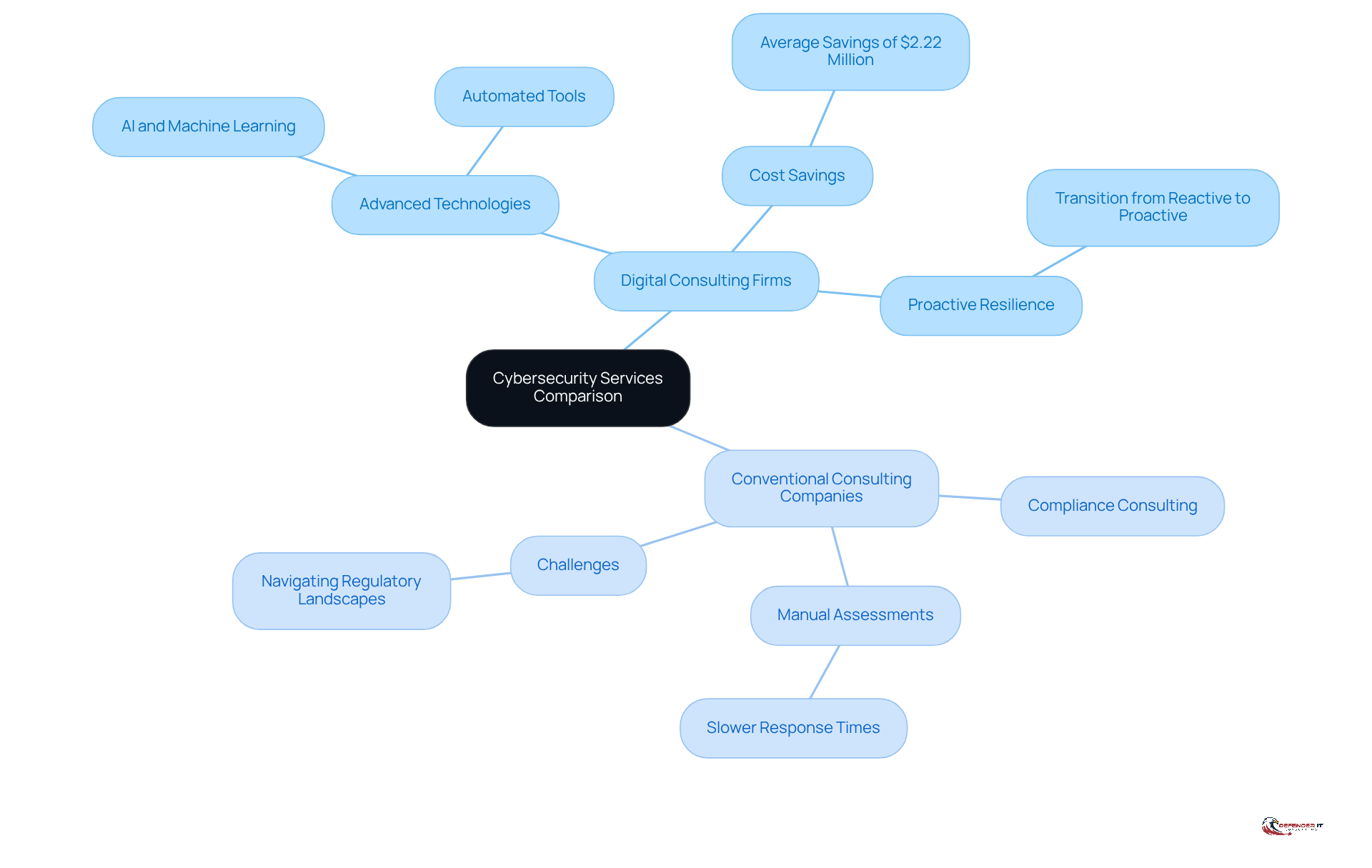
Digital consulting firms are redefining security services by integrating advanced technologies into their digital transformation strategies. These companies leverage AI and machine learning to enhance threat detection and response capabilities. For instance, organizations employing AI-driven tools can save an average of $2.22 million each year by automating tasks and minimizing manual supervision, making their security measures not only more efficient but also cost-effective.
In contrast, while conventional consulting companies provide comparable security services, digital consulting firms often offer a higher level of technological integration. Their focus tends to be more on compliance consulting and risk management, which is particularly beneficial for organizations navigating complex regulatory landscapes. While both types of firms conduct penetration testing, digital firms typically employ automated tools that expedite the process, whereas traditional firms may rely on manual assessments, potentially slowing down response times.
This divergence in approach can create challenges in achieving effective security measures. For instance, the typical expense of a data breach in the manufacturing sector is estimated to be about $4.88 million in 2026, highlighting the essential requirement for prompt and effective security measures. As organizations encounter a growing number of cyber threats, with 71% indicating a rise in cyberattack frequency over the past year, the incorporation of advanced technologies in security services becomes crucial for sustaining a strong security posture. Industry leaders emphasize that transitioning from reactive defense to proactive resilience offers a significant opportunity for fostering strategic business growth, highlighting the importance of innovative solutions in digital security.
Evaluate Pros and Cons of Digital vs. Traditional Consulting for Cybersecurity
Digital consulting firms, while agile and innovative, face significant challenges in delivering personalized service. Their adoption of cutting-edge technologies enables faster threat detection and response times, which is essential in today’s fast-changing cyber landscape. For instance, organizations utilizing AI-driven tools can detect breaches 108 days quicker than conventional methods. Despite their advantages, digital consulting firms often encounter challenges that can impact service quality, such as increased operational expenses.
In contrast, conventional consulting companies offer a wealth of experience and established methodologies, making them valuable for organizations focused on comprehensive risk management and compliance solutions. Their expertise is particularly beneficial in navigating complex regulatory environments. However, this lag in adaptability can lead to vulnerabilities in their cybersecurity offerings, hindering their effectiveness in providing timely and innovative solutions. For example, while a conventional company may excel in compliance consulting, it may not provide the same level of technological integration as a tech-oriented organization that utilizes AI and machine learning.
Statistics show that:
- 51% of cyberattack expenses for small and medium-sized enterprises (SMEs) are due to ransomware, highlighting the necessity for businesses to adopt proactive measures.
- 66% of security leaders find it difficult to keep pace with swift technological progress, emphasizing the need for both online and conventional businesses to adjust their strategies.
Ultimately, the choice between digital consulting firms and conventional consulting firms hinges on an organization’s specific cybersecurity needs and strategic goals.

Assess Suitability of Each Consulting Type for Regulated Industries
Organizations in regulated industries face critical decisions regarding their consulting partnerships that can significantly impact compliance and security outcomes. Digital consulting firms are at the forefront of innovation, providing solutions that blend online security with digital transformation, essential for contemporary organizations. As the global GRC cybersecurity market reached $8.58 billion in 2025 and is projected to grow at a CAGR of 14.8% through 2033, organizations are increasingly recognizing the importance of aligning cybersecurity with business strategy.
Conversely, traditional consulting firms provide essential expertise in navigating complex regulatory environments, making them vital for organizations focused on compliance and risk management. In 2024, the Regulatory & Compliance Management Consulting market was led by large enterprises, which secured over 67.2% of the market share, highlighting the demand for expertise in compliance frameworks and the essential role conventional organizations play in this area.
A financial institution, for instance, may find considerable value in utilizing a conventional firm’s extensive understanding of regulatory compliance while concurrently pursuing a tech firm’s inventive security solutions to enhance its overall security stance. With rising regulatory pressures and digital threats, organizations must carefully consider their consulting options based on their unique needs and strategic goals. Industry leaders emphasize that effective cybersecurity governance is no longer optional, highlighting the necessity for organizations to adopt a comprehensive approach to compliance and risk management. The decision between digital consulting firms and conventional consulting firms will shape not only compliance strategies but also the overall security posture of organizations in an increasingly complex regulatory environment.

Conclusion
Organizations face a critical decision in selecting between digital and traditional consulting firms for cybersecurity and business transformation. Digital consulting firms offer significant advantages, particularly in their ability to integrate advanced technologies like AI for faster threat detection and response. In contrast, traditional firms, while providing valuable expertise in compliance and risk management, often find it challenging to keep pace with the rapid evolution of technology, which can leave organizations exposed to new threats. The importance of aligning cybersecurity strategies with business goals is emphasized, especially for organizations in regulated industries that require both innovative security solutions and comprehensive compliance frameworks.
Ultimately, organizations need to consider their specific needs and strategic objectives when choosing between digital and traditional consulting firms. As the cyber threat landscape continues to evolve, prioritizing proactive cybersecurity measures and embracing innovative technologies will be essential for safeguarding electronic assets. Choosing the right consulting partner is not just a strategic decision; it is a vital step in fortifying an organization’s defenses against the ever-evolving cyber threat landscape.
Frequently Asked Questions
What are digital consulting firms?
Digital consulting firms focus on business transformation through technology and data-driven strategies. They utilize advanced analytics, cloud computing, and online tools to enhance operational efficiency and customer engagement, integrating online security into their digital transformation strategies from the outset.
How do traditional consulting firms differ from digital consulting firms?
Traditional consulting firms emphasize strategic management and operational enhancements without a strong technological focus. Their advisory services are broader and rely on established methodologies, often leading to a reactive approach to cybersecurity, which can leave organizations vulnerable to emerging threats.
Why is cybersecurity important for consulting firms?
Cybersecurity is crucial because traditional consulting firms may struggle to keep pace with the rapidly evolving cyber threat landscape. A proactive approach to cybersecurity is essential for safeguarding electronic assets and ensuring organizations are not left vulnerable.
What is the projected growth of the transformation consulting market?
The transformation consulting market is projected to reach nearly $11 billion by 2026, with 90% of organizations engaged in transformation initiatives.
What should organizations prioritize in the evolving cyber threat landscape?
Organizations must prioritize proactive strategies to safeguard their electronic assets, ensuring they are well-prepared to address emerging threats effectively.
List of Sources
- Define Digital Consulting Firms and Traditional Consulting Firms
- Consulting Industry Trends to Watch in 2026 (https://alpha-sense.com/resources/research-articles/consulting-industry-trends)
- Digital Transformation Trends in 2026 – Insights from the Best Transformation Consulting Firms (https://trndigital.com/blog/digital-transformation-trends-in-2026-insights-from-the-best-transformation-consulting-firms)
- 2026 Consulting Trends: Turning Uncertainty and AI Disruption into Competitive Advantage (https://deltek.com/en/blog/10-key-consulting-moves)
- Digital Consulting Services: What They Are and How They Work (https://nmsconsulting.com/digital-consulting-services-what-they-are-how-they-work-and-when-to-use-them)
- Comparing IT Cyber Security Companies and Traditional Firms – Cygnostic (https://cygnostic.io/comparing-it-cyber-security-companies-and-traditional-firms)
- Compare Cybersecurity Services Offered by Each Firm Type
- New world, new rules: Cybersecurity in an era of uncertainty – The C-suite playbook (https://pwc.com/us/en/services/consulting/cybersecurity-risk-regulatory/library/global-digital-trust-insights.html)
- AI vs. Traditional Cybersecurity: Which Is More Effective? (https://zscaler.com/zpedia/ai-vs-traditional-cybersecurity)
- 205 Cybersecurity Stats and Facts for 2026 (https://vikingcloud.com/blog/cybersecurity-statistics)
- Comparing IT Cyber Security Companies and Traditional Firms – Cygnostic (https://cygnostic.io/comparing-it-cyber-security-companies-and-traditional-firms)
- Key Cyber Security Statistics for 2026 (https://sentinelone.com/cybersecurity-101/cybersecurity/cyber-security-statistics)
- Evaluate Pros and Cons of Digital vs. Traditional Consulting for Cybersecurity
- 8 Challenges Facing Consulting Post Pandemic | Runn (https://runn.io/blog/consulting-challenges)
- Cybersecurity Sayings | Experts Quotes on Cybersecurity | Quotations (https://projectauditors.com/Cyber\_Security\_Dictionary/Cybersecurity\_Sayings\_Quotes\_2.php)
- 205 Cybersecurity Stats and Facts for 2026 (https://vikingcloud.com/blog/cybersecurity-statistics)
- Key Cyber Security Statistics for 2026 (https://sentinelone.com/cybersecurity-101/cybersecurity/cyber-security-statistics)
- Solutions Review: Cybersecurity Awareness Month Quotes from Industry Experts in 2024 – Mark43 (https://mark43.com/press/solutions-review-cybersecurity-awareness-month-quotes-from-industry-experts-in-2024)
- Assess Suitability of Each Consulting Type for Regulated Industries
- Regulatory & Compliance Management Consulting Market (https://market.us/report/regulatory-compliance-management-consulting-market)
- Cybersecurity Consulting for Complex Regulatory Compliance (https://linkedin.com/top-content/consulting/security-consulting-firms/cybersecurity-consulting-for-complex-regulatory-compliance)
- Cybersecurity Compliance Consulting Services (https://kaufmanrossin.com/services/cybersecurity-cio-consulting)
- Regulatory IT Compliance Consulting | CyberSecOp Consulting Services (https://cybersecop.com/regulatory-compliance-consulting)
- Top Cybersecurity Compliance Consulting Firms, 2026 (https://cygnet.one/feeds/blog/top-cybersecurity-compliance-consulting-firms)