Business
Digital Transformation Services Companies vs. Traditional IT: A Comparison
Published June 6, 2026
Introduction
Organizations that resist technological evolution risk falling behind as agile competitors embrace innovation. Digital transformation is essential for improving customer experiences and operational efficiency, compelling companies to reassess their IT service strategies. Organizations face significant challenges when they resist adopting new technologies, risking obsolescence in a rapidly evolving market.
This article delves into the benefits and challenges of both service models, offering insights into how businesses can assess their needs and make informed decisions in an increasingly digital marketplace. Understanding these dynamics is crucial for businesses aiming to thrive in a digital-first environment.
Define Digital Transformation and Traditional IT Services
The integration of electronic technologies across all organizational sectors is reshaping operations and enhancing client value delivery. This transformation marks a shift from traditional, rigid processes to agile, data-driven methodologies. These changes significantly enhance customer experiences and operational efficiency. Key technologies driving this change include:
- Cloud computing
- Artificial intelligence
- Advanced data analytics
By 2026, entities that implement AI transparency will observe their models attain a 50% enhancement in objectives, highlighting the strategic significance of transformation.
In contrast, traditional IT services often involve fixed costs and in-house management, focusing more on maintaining existing systems than on fostering innovation. This rigidity often hinders organizations from embracing necessary innovations. For example, 25% of companies mention security issues and compliance limitations as obstacles in technological transformation, emphasizing the difficulties encountered by enterprises.
As companies focus more on technological transformation, we can clearly see its impact on operational efficiency. For instance, 73% of companies indicate realizing extensive influence from their technological investments, underscoring the need for businesses to adjust to contemporary customer expectations and operational requirements. Industry leaders emphasize that embracing technological transformation is essential for maintaining competitiveness in today’s fast-paced market. Furthermore, merely 30% of entities report considerable enhancement in data quality and reliability, highlighting the difficulties that remain in attaining successful technological transformation. Without embracing technological transformation, organizations may find themselves outpaced by more agile competitors.

Explore Key Components of Digital Transformation Services
In an era where technological advancement dictates market success, digital transformation services companies play a crucial role for businesses aiming to thrive.
- Cloud Computing: This technology facilitates scalability and flexibility, enabling businesses to swiftly adapt to evolving demands. With 94% of companies intending to enlarge their cloud infrastructure, as per PwC’s 2025 EMEA Cloud Business survey, cloud computing continues to be a fundamental aspect of transformation.
- Data Analytics: By providing insights into customer behavior and operational efficiency, data analytics empowers organizations to make informed, data-driven decisions. Organizations that efficiently align their technological transformation efforts with strategy experience a 14% rise in market capitalization, highlighting the significance of analytics in fostering success. As Sharon Rehana emphasizes, data and analytics are the continuous thread that carries digital transformation from start to finish.
- Automation: Automation streamlines processes, minimizes manual errors, and significantly enhances productivity. AI-driven automation not only improves operational efficiency but also allows for real-time decision-making, which is crucial in today’s fast-paced business environment.
- Artificial Intelligence: AI drives advanced analytics and improves interactions with clients, resulting in enhanced service delivery and personalization. Organizations leveraging AI can create hyper-personalized experiences, which are increasingly vital for customer satisfaction and engagement.
- Cybersecurity Strategies: In a period where more than 39% of enterprises encountered a data breach in their cloud environments in 2022, as per the Thales Cloud Security Study, strong cybersecurity strategies are crucial for safeguarding electronic assets and ensuring adherence to regulations, especially in sensitive sectors.
Without embracing digital transformation services companies, businesses risk falling behind competitors who leverage technology for growth. These components work synergistically to create a robust digital ecosystem that enhances overall business performance, driving innovation and competitive advantage. Ultimately, the failure to adopt these digital transformation components could jeopardize an organization’s competitive edge in an increasingly digital marketplace.

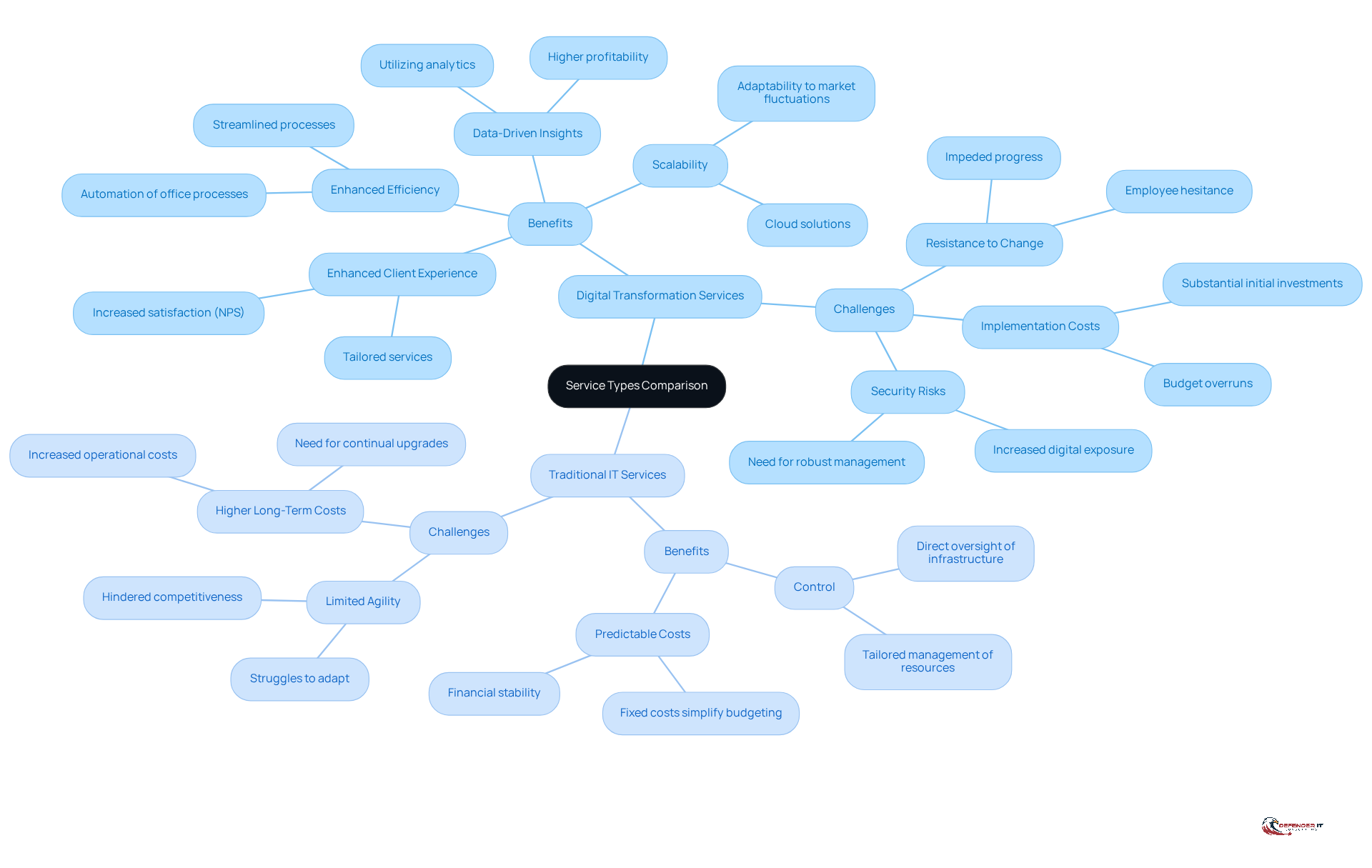
Compare Benefits and Challenges of Each Service Type
Benefits of Digital Transformation Services:
- Enhanced Efficiency: Streamlined processes significantly accelerate operations and reduce costs. For instance, organizations like First Philippine Holdings have automated over 100 office processes, leading to enhanced operational efficiency.
- Enhanced Client Experience: Tailored services and faster response times result in increased satisfaction among clients. A 10-point improvement in Net Promoter Score (NPS) typically translates to a 5-10% increase in revenue from repeat purchases, underscoring the financial impact of improved customer interactions.
- Data-Driven Insights: Utilizing analytics enables entities to make informed decisions. Firms employing advanced analytics report 23% greater profitability compared to those that do not, highlighting the critical role of data in driving success.
- Scalability: Cloud solutions facilitate growth without significant initial investments, allowing entities to effectively manage peak loads and adapt to market fluctuations.
Challenges of Digital Transformation Services:
- Implementation Costs: Implementation Costs pose a significant barrier, as many organizations face substantial initial investments in technology and training, leading to budget overruns that impact 30% of businesses.
- Resistance to Change: Resistance to Change is a common challenge, as employees often hesitate to adopt new technologies and processes, which can impede progress and stall innovation.
- Security Risks: Security Risks are heightened with increased digital exposure, necessitating robust management to safeguard against vulnerabilities, as 25% of entities cite security and compliance constraints as major challenges.
Benefits of Traditional IT Services:
- Control: Control is a key advantage of traditional IT services, as organizations maintain direct oversight of their infrastructure, enabling tailored management of resources and processes.
- Predictable Costs: Fixed costs associated with in-house management simplify budgeting, providing financial stability in operational expenditures.
Challenges of Traditional IT Services:
- Limited Agility: Limited Agility is a significant drawback of traditional IT systems, which often struggle to adapt to changing market demands and technological advancements, hindering competitiveness.
- Higher Long-Term Costs: Maintaining outdated systems can lead to increased operational costs over time, as organizations grapple with inefficiencies and the need for continual upgrades.
Assess Suitability for Different Organizational Needs
Organizations must evaluate their unique needs to determine the most suitable digital transformation or traditional IT services.
Suitability of Digital Transformation Services:
- Fast-Paced Industries: Fast-paced industries, such as technology, finance, and e-commerce, require agility and innovation, making digital transformation services particularly suitable. For example, 80% of financial services participants indicate that their company is either expanding AI implementation throughout the organization or has completely integrated AI, showing a significant trend towards incorporating advanced technologies to improve operational efficiency and client engagement.
- Customer-Centric Businesses: Companies dedicated to improving customer experiences can harness data analytics and automation to adapt to evolving expectations. This belief underscores the potential of AI to enhance service delivery and responsiveness in customer-centric businesses, as statistics show that 93% of health services leaders believe AI agents will facilitate the breakdown of traditional functional silos, enabling more responsive service delivery. Additionally, 83% of respondents believe AI agents and automation will accelerate this breakdown across various industries, highlighting the widespread impact of these technologies.
- Growth-Oriented Firms: Growth-oriented firms can benefit from cloud solutions that allow for scalable operations without significant infrastructure investments. This approach allows for flexibility and responsiveness in meeting market demands.
Suitability of Traditional IT Services:
- Stable Environments: Organizations with stable operations and minimal need for rapid change may find traditional IT services adequate. Thus, stable environments may find traditional IT services to be a reliable choice for maintaining existing systems.
- Budget-Conscious Firms: Budget-conscious firms often favor traditional IT services due to their predictable cost structures, which aid in effective expense management.
- Regulatory Compliance: Consequently, regulatory compliance is a critical factor where traditional IT services can provide necessary oversight and control, ensuring compliance while maintaining operational integrity.
Ultimately, the choice between digital transformation services companies and traditional IT services depends on an organization’s specific operational context and strategic goals.

Conclusion
The transition from traditional IT services to digital transformation services represents a critical shift in organizational strategy. Embracing digital transformation not only enhances efficiency but also aligns businesses with contemporary market demands and customer expectations. This transition is not just beneficial; it is essential for maintaining competitiveness and fostering innovation in an increasingly digital landscape.
Key components driving digital transformation include:
- Cloud computing
- Data analytics
- Automation
- Cybersecurity
These elements work together to create a dynamic ecosystem that improves operational efficiency, enhances customer experiences, and ultimately leads to greater profitability. In contrast, traditional IT services, while offering stability and predictability, often fall short in agility and adaptability, making them less suited for organizations seeking to thrive in fast-paced environments.
When organizations assess their technological needs, they must weigh the challenges and opportunities of both digital transformation and traditional IT services. By recognizing the importance of embracing digital transformation, businesses can position themselves for success, ensuring they remain relevant and competitive in an evolving marketplace. However, organizations often face significant challenges in implementing these changes, which can deter progress. This adaptation is crucial for long-term sustainability and market relevance. Taking decisive steps towards digital transformation is not just a choice; it is a necessity for future growth and sustainability. Ultimately, organizations that prioritize digital transformation will not only survive but thrive in the future marketplace.
Frequently Asked Questions
What is digital transformation?
Digital transformation refers to the integration of electronic technologies across all organizational sectors, reshaping operations and enhancing the delivery of client value. It signifies a shift from traditional, rigid processes to agile, data-driven methodologies.
What are the key technologies driving digital transformation?
The key technologies driving digital transformation include cloud computing, artificial intelligence, and advanced data analytics.
How does digital transformation impact customer experiences and operational efficiency?
Digital transformation significantly enhances customer experiences and operational efficiency by allowing organizations to adapt to contemporary customer expectations and operational requirements more effectively.
What challenges do organizations face with traditional IT services?
Traditional IT services often involve fixed costs and in-house management, focusing more on maintaining existing systems rather than fostering innovation. This rigidity can hinder organizations from embracing necessary technological innovations.
What percentage of companies cite security issues and compliance limitations as obstacles to technological transformation?
25% of companies mention security issues and compliance limitations as obstacles in their technological transformation efforts.
What impact do technological investments have on companies?
73% of companies indicate that they realize extensive influence from their technological investments, highlighting the importance of adapting to technological changes.
How successful are organizations in enhancing data quality and reliability through technological transformation?
Only 30% of entities report considerable enhancement in data quality and reliability, indicating that challenges remain in achieving successful technological transformation.
Why is embracing technological transformation essential for organizations?
Embracing technological transformation is essential for maintaining competitiveness in today’s fast-paced market. Organizations that do not adapt may find themselves outpaced by more agile competitors.
List of Sources
- Define Digital Transformation and Traditional IT Services
- How Digital Transformation Is Changing In 2026 (https://nextiva.com/blog/digital-transformation-trends.html)
- PwC’s 2026 Digital Trends in Operations: How AI Reinvents Enterprise Performance (https://pwc.com/us/en/services/consulting/supply-chain-operations/library/digital-trends-operations-survey.html)
- State of Digital Transformation 2026: Enhancing Digital Strategy (https://teksystems.com/en/insights/state-of-digital-transformation-2026)
- Digital Transformation in 2026: Strategies, Benefits, & Real-World Examples | Splunk (https://splunk.com/en\_us/blog/learn/digital-transformation.html)
- Top Digital Transformation Trends and Strategies for 2026 (https://rishabhsoft.com/blog/digital-transformation-trends)
- Explore Key Components of Digital Transformation Services
- Dassault Systèmes blog (https://blog.3ds.com/topics/company-news/the-ultimate-guide-to-cloud-digital-transformation)
- How AI and Data Analytics Drive Digital Transformation (https://intellectyx.com/how-ai-and-data-analytics-accelerating-digital-transformation)
- The Critical Role Data and Analytics Plays in Your Digital Transformation (https://analytics8.com/blog/the-critical-role-data-and-analytics-plays-in-your-digital-transformation)
- Cloud Computing Market Size, Share & Growth Report, 2034 (https://fortunebusinessinsights.com/cloud-computing-market-102697)
- Why Data Analytics is Important for Digital Transformation? (https://imd.org/blog/digital-transformation/the-role-of-data-analytics)
- Compare Benefits and Challenges of Each Service Type
- 7 Digital Transformation Challenges to Overcome in 2026 (https://kissflow.com/digital-transformation/digital-transformation-challenges)
- State of Digital Transformation 2026: Enhancing Digital Strategy (https://teksystems.com/en/insights/state-of-digital-transformation-2026)
- 10 benefits of digital transformation for businesses in 2026 – iwis (https://iwis.io/en/blog/digital-transformation-benefits)
- Digital Transformation Statistics and Facts (https://market.us/statistics/information-and-communication/digital-transformation)
- Digital Transformation in 2026: Strategies, Benefits, & Real-World Examples | Splunk (https://splunk.com/en\_us/blog/learn/digital-transformation.html)
- Assess Suitability for Different Organizational Needs
- State of Digital Transformation 2026: Enhancing Digital Strategy (https://teksystems.com/en/insights/state-of-digital-transformation-2026)
- Why Are Organizations Prioritizing Digital Transformation… (https://skill-mine.com/why-are-organizations-prioritizing-digital-transformation-services-in-2026)
- PwC’s 2026 Digital Trends in Operations: How AI Reinvents Enterprise Performance (https://pwc.com/us/en/services/consulting/supply-chain-operations/library/digital-trends-operations-survey.html)
- Achieving Customer-centricity through Digital Transformation (https://wns.com/perspectives/articles/achieving-customer-centricity-through-digital-transformation)
- Digital Transformation in 2026: Strategies, Benefits, & Real-World Examples | Splunk (https://splunk.com/en\_us/blog/learn/digital-transformation.html)