Business
Engage GDPR Compliance Specialists: Best Practices for Executives
Published June 28, 2026
Introduction
Navigating GDPR compliance presents significant challenges for executives in today’s data-driven landscape. As organizations face increasing scrutiny over their data management practices, working with GDPR compliance specialists is essential to ensure legal adherence and foster trust with customers and stakeholders. By collaborating effectively with GDPR specialists, executives can streamline compliance processes and build stronger relationships with stakeholders.
Understand GDPR Fundamentals and Importance
Understanding the General Data Protection Regulation (GDPR) is crucial for executives navigating the complexities of privacy law and its implications for their organizations. This regulation, effective May 2018, enhances individuals’ control over their personal information. For executives, understanding GDPR is essential for several reasons:
- Legal Compliance: Non-compliance can lead to fines of up to €20 million or 4% of annual global turnover, whichever is higher.
- Reputation Management: Organizations that prioritize information protection build trust with customers, which is vital in today’s digital economy.
- Operational Efficiency: Applying privacy regulations can enhance information management processes, resulting in better operational efficiency.
- Risk Mitigation: Comprehending the General Data Protection Regulation aids in recognizing possible threats linked to information management and processing, enabling proactive actions to be implemented.
This understanding not only ensures compliance but also positions organizations to thrive in a data-driven landscape.

Identify Roles and Expertise of Compliance Specialists
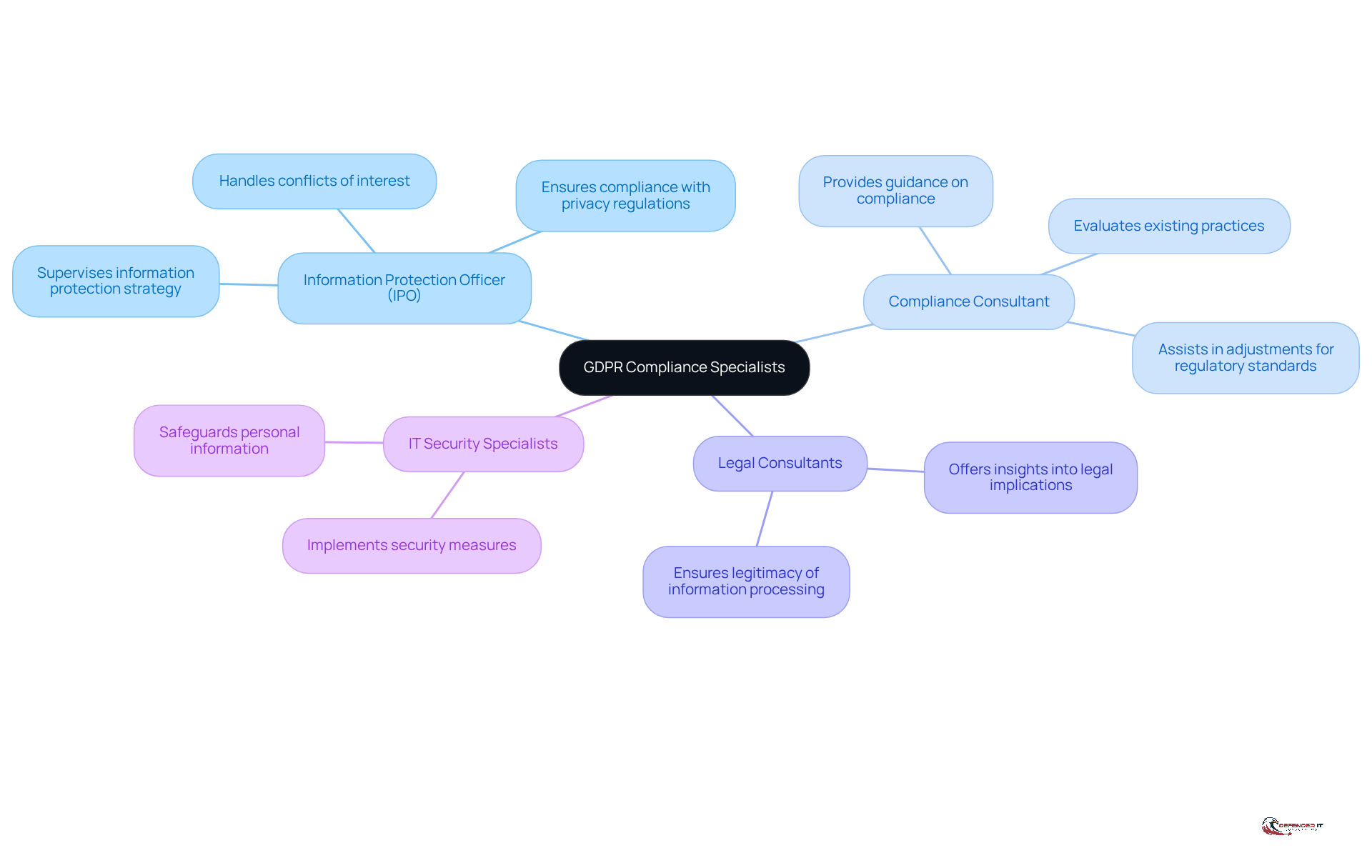
The effective execution and continuous upkeep of data protection compliance necessitate the hiring of GDPR compliance specialists. Key roles include:
- Information Protection Officer (IPO): The IPO supervises the information protection strategy and execution, ensuring compliance with privacy regulations. This position is essential, particularly as companies encounter growing scrutiny concerning data management practices. Yet, internal DPOs might face conflicts that could compromise their independence and objectivity.
- Compliance Consultant: These experts provide valuable guidance on data protection compliance, assisting organizations in evaluating their existing practices and making necessary adjustments to adhere to regulatory standards.
- Legal Consultants: They offer insights into the legal implications of the General Data Protection Regulation, ensuring that all information processing activities are legitimate and compliant with current regulations.
- IT Security Specialists: Focused on the technical aspects of information protection, these experts implement security measures to safeguard personal information against breaches and unauthorized access.
The demand for skilled data protection specialists is on the rise, with projections indicating average salaries ranging from USD 100,000 to 200,000 per year in the U.S. and Western Europe by 2026. Understanding these roles is essential for executives aiming to navigate the complexities of data protection regulations and collaborate with GDPR compliance specialists to build a foundation of trust with stakeholders.
Implement Effective Collaboration Strategies
To achieve compliance with data protection regulations, organizations must prioritize interdepartmental collaboration. Here are effective strategies:
- Cross-Functional Teams: Form groups that consist of individuals from IT, legal, regulatory, and operations to ensure all viewpoints are taken into account in regulatory efforts.
- Consistent Communication: Arrange frequent meetings to discuss adherence progress, challenges, and updates on data protection regulations.
- Shared Goals: Align departmental objectives with overall compliance goals to ensure that everyone is working towards the same outcomes.
- Training and Awareness: Provide training sessions that involve all departments to raise awareness about data protection regulations and their implications for their specific roles.
Achieving compliance with data protection regulations requires ongoing commitment and collaboration. By implementing these strategies, organizations can cultivate a pervasive culture of adherence that permeates all levels of the organization, ultimately enhancing their success rates in data protection compliance. Strong leadership and clear accountability are essential to overcoming common challenges faced by cross-functional teams, such as misalignment of priorities and unclear governance. As noted, collaboration among departments can prevent regulatory challenges from arising late in the compliance process, emphasizing the importance of proactive engagement in adherence efforts.

Promote Ongoing Education and Training
Ensuring compliance with data protection regulations hinges on the expertise of gdpr compliance specialists and continuous education and training for all employees. Implementing best practices for continuous learning can significantly enhance compliance efforts:
- Regular Training Sessions: Conduct training sessions at least once a year, with updates whenever major changes to data protection regulations occur. Regular training effectively reduces financial risks linked to non-compliance. It helps maintain compliance, and gdpr compliance specialists keep employees informed about evolving requirements.
- E-Learning Modules: Utilize online training modules that allow employees to learn at their own pace, ensuring flexibility and accessibility. E-learning modules have proven effective in reducing unintentional data loss and unauthorized disclosures, making them a practical training solution.
- Assessment and Feedback: Regularly evaluate employees’ understanding of data protection regulations through quizzes and feedback sessions. This practice helps identify knowledge gaps and areas needing improvement, fostering a culture of continuous learning.
- Incorporate Real-World Scenarios: Use case studies and real-world examples to illustrate the importance of adherence and the potential consequences of non-adherence. Consistent training promotes a security-first culture, involving employees and strengthening the practical implications of data protection compliance.
Furthermore, it is essential to acknowledge that Article 24 of GDPR requires entities to implement necessary measures, including staff training provided by gdpr compliance specialists, to ensure adherence. By fostering a culture of continuous learning, organizations not only comply with regulations but also enhance their overall data protection posture. Ultimately, a well-informed workforce is the first line of defense against data breaches and compliance failures.

Conclusion
Navigating the complexities of GDPR compliance requires a strategic approach that prioritizes collaboration and education. Understanding and engaging GDPR compliance specialists is essential for executives aiming to effectively manage data protection regulations. By prioritizing compliance, organizations not only mitigate legal risks but also enhance their reputation and operational efficiency. Integrating GDPR principles into business practices builds trust and accountability, essential in today’s data-driven world.
The article highlights the importance of recognizing the various roles of GDPR compliance specialists, such as:
- Information Protection Officers
- Compliance consultants
- IT security specialists
Each role contributes uniquely to the overarching goal of data protection, emphasizing the need for collaboration across departments. This collaboration not only streamlines compliance efforts but also enhances overall organizational performance, ensuring that compliance initiatives are cohesive and comprehensive.
In conclusion, fostering a culture of ongoing education and training is paramount for maintaining GDPR compliance. Organizations must invest in continuous learning initiatives to equip their workforce with the knowledge necessary to navigate evolving regulations. This commitment not only ensures compliance but also fortifies defenses against potential data breaches. By embracing these best practices, organizations can position themselves as leaders in data protection, ensuring long-term success in an increasingly regulated landscape.
Frequently Asked Questions
What is the General Data Protection Regulation (GDPR)?
The GDPR is a regulation that enhances individuals’ control over their personal information and is crucial for organizations to understand in order to navigate privacy law complexities.
When did the GDPR come into effect?
The GDPR became effective in May 2018.
Why is understanding GDPR important for executives?
Understanding GDPR is important for executives for several reasons, including ensuring legal compliance, managing reputation, enhancing operational efficiency, and mitigating risks associated with information management.
What are the potential consequences of non-compliance with GDPR?
Non-compliance with GDPR can lead to fines of up to €20 million or 4% of annual global turnover, whichever is higher.
How does GDPR impact reputation management for organizations?
Organizations that prioritize information protection under GDPR build trust with customers, which is essential in the digital economy.
In what ways can GDPR enhance operational efficiency?
Applying privacy regulations like GDPR can improve information management processes, leading to better operational efficiency.
How does understanding GDPR help in risk mitigation?
Comprehending GDPR helps organizations recognize potential threats related to information management and processing, allowing them to take proactive measures.
List of Sources
- Understand GDPR Fundamentals and Importance
- GDPR Compliance in 2026: The Complete Guide (https://secureprivacy.ai/blog/gdpr-compliance-2026)
- How Does GDPR Affect Businesses: Impact Guide for 2026 – GDPR Local (https://gdprlocal.com/how-gdpr-affects-businesses)
- Data privacy in 2026: How GDPR compliance landscape is evolving (https://tjc-group.com/blogs/data-privacy-in-2026-how-gdpr-compliance-landscape-is-evolving)
- Understanding the Financial Impact of GDPR on Businesses (https://2wtech.com/understanding-the-financial-impact-of-gdpr-on-businesses)
- How Has the GDPR Affected Business? (https://businessnewsdaily.com/15510-gdpr-in-review-data-privacy.html)
- Identify Roles and Expertise of Compliance Specialists
- Data protection digest 19 May – 2 Jun 2026: Delayed application of high-risk AI rules & GDPR roles in cloud technology – TechGDPR (https://techgdpr.com/blog/data-protection-digest-02062026-delayed-application-of-high-risk-ai-rules-gdpr-roles-in-cloud-technology)
- Why Every Organization Needs Certified Data Protection Officers (https://gsdcouncil.org/blogs/why-every-organization-needs-certified-data-protection-officers)
- GDPR Compliance: The Critical Role of Data Protection Officers | UpGuard (https://upguard.com/blog/data-protection-officers)
- The role of a Data Protection Officer in GDPR compliance, a complete guide – Thoropass (https://thoropass.com/blog/data-protection-officer)
- GDPR Roles And Responsibilities: A Practical Guide with Steps (2026) | Konfirmity (https://konfirmity.com/blog/gdpr-roles-and-responsibilities)
- Implement Effective Collaboration Strategies
- Cross-Functional Compliance Collaboration – Adherent (https://complianceandrisks.com/blog/cross-functional-compliance-collaboration-how-to-break-down-silos-and-build-products-that-ship-on-time)
- Cross-Functional Collaboration for Compliance Success – UberEther (https://uberether.com/cross-functional-collaboration-for-compliance-success)
- Cross-Functional Teams Boost Compliance Success, TechClass (https://techclass.com/resources/learning-and-development-articles/cross-functional-teams-hidden-asset-in-compliance-programs)
- A Complete Guide to GDPR Compliance for Applications (https://securitycompass.com/blog/gdpr-compliance-for-your-applications-a-comprehensive-guide)
- The impacts of GDPR on global organizations (https://cloudi-fi.com/blog/the-impacts-of-gdpr-on-global-organizations-after-6-years-of-implementation)
- Promote Ongoing Education and Training
- The Importance of GDPR Training For Employees | FE News (https://fenews.co.uk/skills/the-importance-of-gdpr-training-for-employees)
- GDPR Training Requirements: Everything You Need to Know | DPO Consulting (https://dpo-consulting.com/blog/gdpr-training-requirements)
- GDPR Training (https://hipaajournal.com/gdpr-training)
- Top GDPR Training Courses to Build Compliance Culture (https://sprinto.com/blog/gdpr/training-courses)
- Benefits of GDPR Training for Employees | Improve Compliance & Security | NetMonkeys (https://netmonkeys.co.uk/benefits-of-gdpr-training-for-employees-improve-compliance-security)