Business
Who is Building AI Data Centers? Key Players and Insights
Published July 4, 2026
Introduction
The rapid adoption of artificial intelligence is fundamentally transforming data management, highlighting the urgent need for specialized AI data centers. These facilities represent a critical evolution in how organizations process and analyze vast amounts of data, leveraging advanced technologies to meet the demands of AI workloads. As organizations strive to keep pace with technological advancements, they encounter significant hurdles in infrastructure development. Understanding the dynamics of this transformation is essential for organizations aiming to thrive in an increasingly data-driven landscape.
Define AI Data Center: Purpose and Functionality
As organizations increasingly rely on artificial intelligence, the need for specialized AI processing facilities has never been more critical. AI processing facilities are designed to manage the demanding computational tasks linked to artificial intelligence (AI) workloads. Unlike conventional centers that primarily handle general computing tasks, AI centers are tailored for high-performance computing. They utilize advanced hardware, including Graphics Processing Units (GPUs) and Tensor Processing Units (TPUs), to efficiently handle large volumes of information. This infrastructure is vital for organizations to effectively leverage AI technologies at scale, enabling tasks such as machine learning, deep learning, and real-time information analysis.
By 2026, the AI facility potential in the United States is projected to reach 8.2 GW, accounting for 40% of total installed capacity, and is expected to grow to 26.4 GW by 2031, representing 54% of overall potential. This rapid growth underscores the increasing reliance on AI-driven solutions across various industries.
Case studies demonstrate the changing environment of AI facilities. For example, Japan intends to increase its AI-specific infrastructure from 1 GW in 2026 to 2.6 GW by 2031, emphasizing renewable energy and collaborations with leading firms. Furthermore, the U.S. is poised to lead in AI infrastructure, propelled by substantial investments from technology leaders such as AWS and Microsoft, which are essential for meeting the growing demand for AI applications. Microsoft, for instance, declared a CAD 7.5 billion investment over the next two years to improve AI infrastructure capacity in Canada. The evolution of AI infrastructure not only shapes organizational capabilities but also defines the competitive landscape in the digital age.

Contextualize the Rise of AI Data Centers: Evolution and Importance
The rapid advancement of AI technologies has highlighted the limitations of traditional information hubs. As companies increasingly adopt AI for tasks such as natural language processing, image recognition, and predictive analytics, the shortcomings of these conventional facilities are becoming evident. They often struggle to handle the demands of AI workloads, lacking the necessary computational power and information throughput.
This evolution has spurred significant innovations in both hardware and software. For instance, the integration of graphics processing units (GPUs) and specialized cooling systems has become essential to meet the demands of high-density AI operations. Additionally, advancements in software have optimized resource allocation, enhancing efficiency and performance.
The importance of AI facilities extends beyond mere infrastructure; they are crucial in enabling the rapid advancement and implementation of AI technologies that are transforming industries and driving economic growth. As AI training workloads are expected to triple each year until 2030, this escalating demand necessitates the development of specialized facilities capable of supporting these intensive processes. An extra 250GW of resources will be needed under an aggressive scenario by June 1, 2026.
Recent advancements emphasize this trend: in 2026, companies who are building AI data centers increased, with Texas representing 6.5GW of a total of 35GW in facility capacity under construction in the U.S., positioning it to become the largest market worldwide by 2030. This growth is not without challenges, as operators must navigate issues such as energy consumption and water usage, particularly in regions already facing resource constraints. Data facilities utilize up to 5 million gallons of water each day for cooling, highlighting the sustainability challenges encountered by the industry.
Experts believe that the future of AI facilities hinges on their ability to adapt to these challenges while fostering innovation. As Sean James, a distinguished engineer for energy systems at Nvidia, observes, “Data facilities need to engineer out water where they can,” emphasizing the significance of sustainability in this rapidly evolving landscape. Moreover, community opposition has effectively obstructed or postponed $98 billion in information hub projects from March to June 2025, demonstrating the difficulties and resistance encountered by such developments. The ability to innovate while addressing sustainability challenges will determine the future success of AI facilities.

Identify Key Characteristics: Differences from Traditional Data Centers
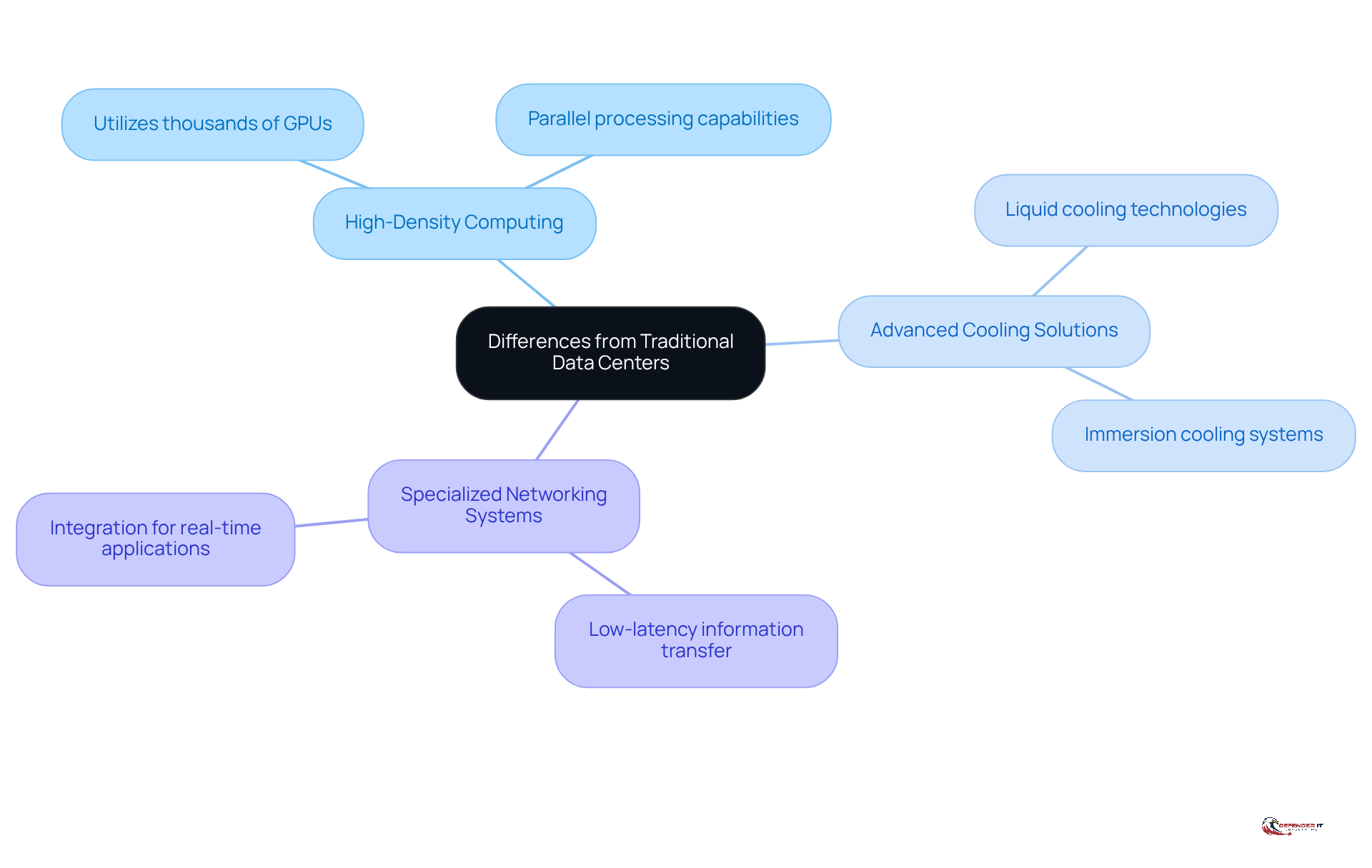
Organizations must adapt to the unique infrastructure demands of AI technologies to remain competitive in the evolving landscape of artificial intelligence. AI facilities differ from conventional facilities in several significant ways:
- High-Density Computing: AI facilities are designed to accommodate high-density computing, often utilizing thousands of GPUs for parallel processing tasks. In contrast, conventional computing facilities typically rely on CPUs for general-purpose processing.
- Advanced Cooling Solutions: The heat generated by high-performance hardware necessitates advanced cooling solutions in AI facilities. This has led to the adoption of liquid cooling and immersion cooling technologies.
- Specialized Networking Systems: AI facilities frequently integrate specialized networking systems to ensure low-latency information transfer, which is crucial for real-time AI applications.
These characteristics enable AI facilities to effectively manage the unique requirements of AI tasks. The integration of these advanced facilities is not merely beneficial; it is essential for organizations aiming to leverage AI technologies effectively.
Explore Who is Building AI Data Centers: Key Industry Players
The rapid evolution of AI technology necessitates a robust infrastructure, driven by significant investments from leading tech companies. Microsoft leads the charge with a $3 billion investment in a 1.2 million square foot AI facility in Wisconsin. This facility is expected to become the most advanced AI hub globally. Amazon Web Services (AWS) and Google are also making notable strides; AWS is expanding its storage capabilities, while Google is investing in new locations to enhance its AI offerings.
Emerging companies like CoreWeave and Digital Realty, who is building AI data centers, are stepping up as key players in the AI facility landscape, focusing on delivering the resources required for intensive AI tasks. CoreWeave specializes in GPU-as-a-service, catering specifically to AI applications, while Digital Realty is enhancing its colocation services to meet the growing demands of AI-driven enterprises.
Construction firms such as Turner Construction and AECOM are vital to the physical development of these facilities, ensuring they meet the stringent requirements of AI technologies. This collaboration between technology leaders and construction companies underscores the necessity for specialized facilities in the ongoing AI revolution.
By 2026, global investment in AI infrastructure is projected to approach nearly $7 trillion, with major players like Microsoft, AWS, and Google leading the way. Their commitment to building robust AI infrastructure is reshaping the data center landscape and setting the stage for the future of AI applications across various sectors, particularly by those who are building AI data centers. As the industry evolves, addressing environmental concerns will be crucial to sustaining growth and innovation in AI infrastructure.

Conclusion
The rapid evolution of AI data centers is reshaping the technological landscape, driven by an urgent demand for specialized infrastructure to support advanced applications. As organizations strive to harness the power of AI, the construction and development of dedicated facilities have become essential, with industry leaders investing billions to meet this demand. AI data centers signify a fundamental shift in computational task management, moving beyond traditional data center upgrades and emphasizing high-performance computing and advanced technologies.
Key insights reveal that major players like Microsoft, AWS, and Google are at the forefront of this transformation. They are investing heavily in building state-of-the-art AI facilities. The unique characteristics of AI data centers, such as high-density computing, advanced cooling solutions, and specialized networking systems, distinguish them from conventional facilities. However, the rapid evolution of AI data centers is accompanied by significant challenges, particularly in sustainability and resource management. As the industry anticipates a significant increase in AI workloads, the importance of these specialized infrastructures cannot be overstated.
Looking ahead, the future of AI data centers hinges on the ability of industry leaders to navigate these challenges while fostering innovation. This substantial investment signals a transformative shift in the digital landscape, emphasizing the need for sustainable practices in AI infrastructure development. As organizations continue to embrace AI technologies, it is imperative for stakeholders to prioritize sustainable practices and collaborative efforts, ensuring that the growth of AI data centers aligns with environmental considerations. Ultimately, the future of AI data centers will depend on the industry’s commitment to sustainability and innovation, ensuring that technological advancements do not come at the expense of environmental responsibility.
Frequently Asked Questions
What is the purpose of AI data centers?
AI data centers are specialized facilities designed to manage the demanding computational tasks associated with artificial intelligence workloads, enabling organizations to leverage AI technologies effectively.
How do AI data centers differ from conventional data centers?
Unlike conventional data centers that primarily handle general computing tasks, AI data centers are tailored for high-performance computing and utilize advanced hardware such as Graphics Processing Units (GPUs) and Tensor Processing Units (TPUs) to efficiently process large volumes of information.
What types of tasks can AI data centers handle?
AI data centers can handle tasks such as machine learning, deep learning, and real-time information analysis.
What is the projected growth of AI facilities in the United States by 2031?
By 2031, the AI facility potential in the United States is expected to grow to 26.4 GW, representing 54% of the overall potential.
How is Japan planning to enhance its AI infrastructure?
Japan intends to increase its AI-specific infrastructure from 1 GW in 2026 to 2.6 GW by 2031, focusing on renewable energy and collaborations with leading firms.
Which companies are making significant investments in AI infrastructure?
Technology leaders such as AWS and Microsoft are making substantial investments in AI infrastructure, with Microsoft announcing a CAD 7.5 billion investment over the next two years to enhance AI capacity in Canada.
Why is the evolution of AI infrastructure important for organizations?
The evolution of AI infrastructure shapes organizational capabilities and defines the competitive landscape in the digital age, making it essential for meeting the growing demand for AI applications.
List of Sources
- Define AI Data Center: Purpose and Functionality
- AI Data Centers Recent News | Data Center Knowledge (https://datacenterknowledge.com/next-gen-data-centers/ai-data-centers)
- Where Is AI Data Center Demand Growth Being Driven? (https://abiresearch.com/blog/ai-data-center-demand-growth)
- Can US infrastructure keep up with the AI economy? (https://deloitte.com/us/en/insights/industry/power-and-utilities/data-center-infrastructure-artificial-intelligence.html)
- Topic: AI data centers (https://statista.com/topics/13816/ai-data-centers?srsltid=AfmBOoqiNTiq9LXIyB99dA29wyP9Rr0kgzIU8P2SNG7XjiS7B0IxWO-N)
- AI Data Center Market Size, Growth Report, 2026-2033 (https://grandviewresearch.com/industry-analysis/ai-data-center-market-report)
- Contextualize the Rise of AI Data Centers: Evolution and Importance
- Data Center World 2026: AI Pushes Infrastructure to New Limits (https://datacenterknowledge.com/build-design/data-center-world-2026-ai-pushes-infrastructure-to-new-limits)
- What AI Bubble? Data Center Market Will Expand 14% In 2026; Report (https://investors.com/news/data-center-ai-nvidia-alphabet-google-amazon-meta-tsmc-energy-real-estate)
- AI Data Centers: Big Tech’s Impact on Electric Bills, Water, and More – Consumer Reports (https://consumerreports.org/data-centers/ai-data-centers-impact-on-electric-bills-water-and-more-a1040338678)
- AI data center demand “larger than we’re prepared for” despite “existential investment” – report (https://datacenterdynamics.com/en/news/ai-data-center-demand-larger-than-were-prepared-for-despite-existential-investment-report)
- Identify Key Characteristics: Differences from Traditional Data Centers
- AI Data Centers Recent News | Data Center Knowledge (https://datacenterknowledge.com/next-gen-data-centers/ai-data-centers)
- The future of data centers | Brookings (https://brookings.edu/articles/the-future-of-data-centers)
- Can US infrastructure keep up with the AI economy? (https://deloitte.com/us/en/insights/industry/power-and-utilities/data-center-infrastructure-artificial-intelligence.html)
- The Impact of AI on Data Center Markets | News & Insights | Gray (https://gray.com/insights/the-impact-of-ai-on-data-center-markets)
- AI data center vs traditional data center – what is the (https://rcrwireless.com/20250327/fundamentals/ai-data-center-difference)
- Explore Who is Building AI Data Centers: Key Industry Players
- AI Data Center Build Advances at Full Speed: Five Things to Know | BloombergNEF (https://about.bnef.com/insights/data-centers/ai-data-center-build-advances-at-full-speed-five-things-to-know)
- Inside Microsoft’s Plans for the ‘Most Advanced AI Data Center in the World’ (https://wsj.com/articles/inside-microsofts-plans-for-the-most-advanced-ai-data-center-in-the-world-ee50bd4c)
- Microsoft Commits $80B to AI Data Center Expansion Through 2028 (https://datacenters.com/news/microsoft-s-80b-investment-in-ai-data-centers-the-digital-backbone-for-a-multimodal-world)
- Measuring the Data Center Boom: Facts and Statistics (2026) (https://programs.com/resources/data-center-statistics)
- Majority of US’s new AI datacenters to be built on drought-hit land (https://theguardian.com/us-news/2026/jun/08/datacenter-ai-drought-water)